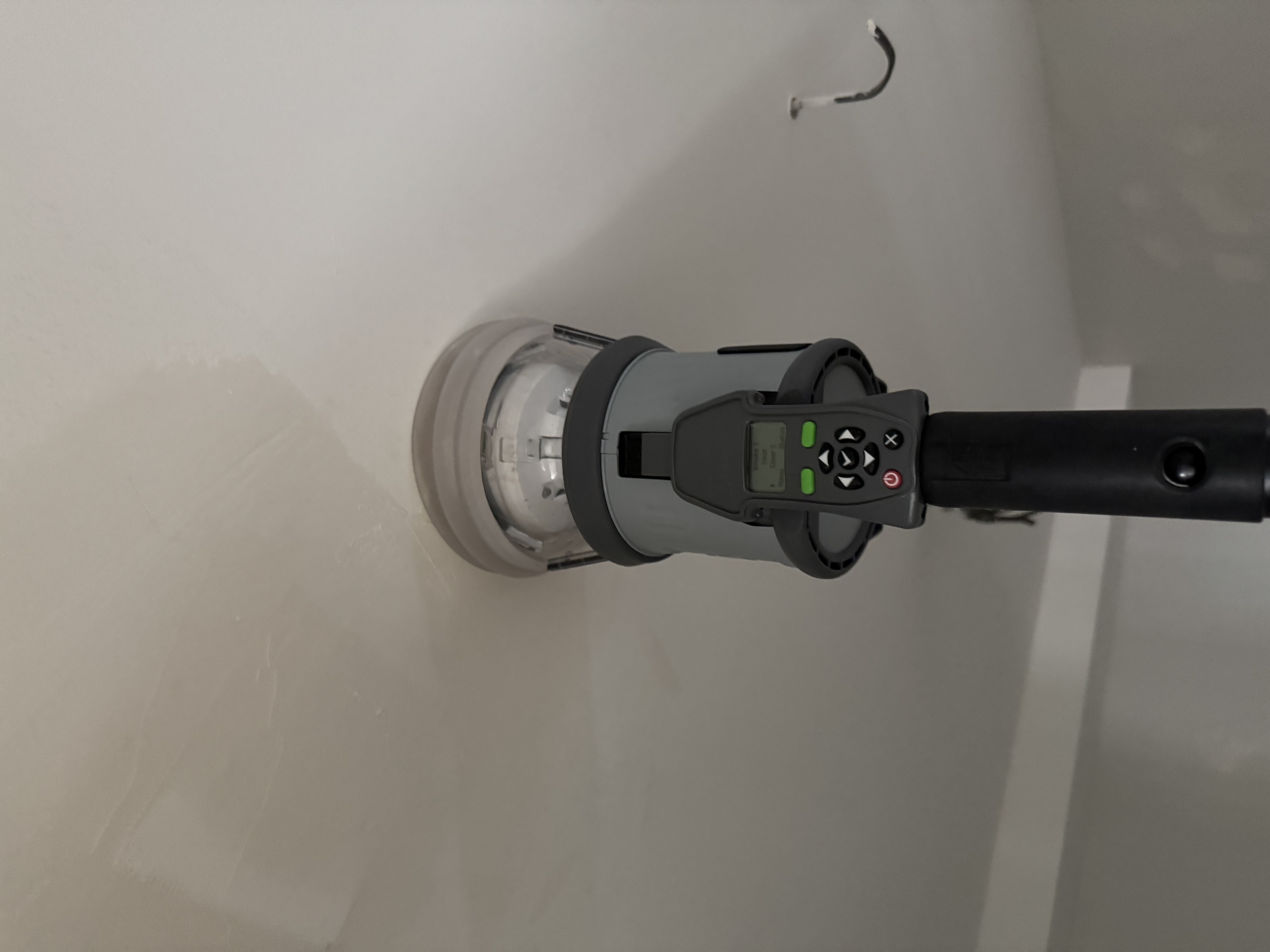
Our accreditations
 NICEIC Approved Contractor
 NICEIC Domestic Installer
 NICEIC PAT Registered
 City & Guilds
What Our Customers Say
Real feedback from property managers, landlords and businesses — verified on Google.
Tony Mann
Local Guide · Milton Keynes
✓ Verified Google Review
Taya Cleghorn
Business Owner · Bedford
Marina Azhar
Property Manager · London
Tony Mann
Local Guide · Milton Keynes
✓ Verified Google Review
Taya Cleghorn
Business Owner · Bedford
Marina Azhar
Property Manager · London
What is fire alarm testing?
Fire alarm testing — formally called periodic inspection and servicing — is a structured inspection and functional test of every component in a fire detection and alarm system, carried out to the requirements of BS 5839-1, the British Standard for fire detection and alarm systems in buildings.
The engineer tests every detector, call point, sounder, beacon, control panel, and interconnection. Battery condition, wiring integrity, detector sensitivity, and cause-and-effect logic are all checked. You receive a formal service record detailing every device tested, the results, and any faults found — along with their risk classification.
The overall outcome is either Satisfactory — the system is fully operational and compliant at the time of inspection — or Unsatisfactory, meaning faults or deficiencies were found that require remedial action before the system can be relied upon.
System categories under BS 5839-1
Life protection systems
Automatic detection providing early warning to occupants. L1 gives full building coverage; L2–L5 provide progressively more limited coverage, down to defined high-risk areas or escape routes only.
Property protection systems
Automatic detection primarily for early fire discovery in unoccupied premises to limit property damage. P1 covers the whole building; P2 covers defined high-risk areas only.
Manual systems
Manual call points and sounders only — no automatic detection. Relies entirely on occupants to discover and raise the alarm. Often the minimum provision for small, low-risk premises.
Source: BS 5839-1:2017+A1:2020
When is testing required?
Commercial Premises
BS 5839-1 requires a minimum of two full inspections and tests per year (six-monthly visits) by a competent engineer, plus a short visit annually to test all devices not covered in the six-monthly schedule. The responsible person must also carry out a weekly call-point test and log the result.
HMOs & Residential Blocks
Houses in multiple occupation require a fire alarm system maintained in good working order as a condition of HMO licensing. Local authorities routinely require evidence of six-monthly servicing by a competent engineer. Failure to produce records can lead to licence refusal or revocation.
Care Homes & Healthcare
Premises regulated by the Care Quality Commission must demonstrate that fire safety systems are regularly maintained. Inspectors expect to see current service records at every visit. Six-monthly engineering inspections are the baseline requirement.
After Any Alteration or Fault
Any significant building alteration, extension, change of use, or fire event requires a review and re-test of the affected zones. Where a fault has caused the system to operate in a degraded state, it must be restored and retested before normal occupancy can be considered safe.
Why is it a legal requirement?
Regulatory Reform (Fire Safety) Order 2005
The responsible person for any non-domestic premises must ensure that all fire safety equipment — including fire detection and alarm systems — is maintained in an efficient state, in efficient working order, and in good repair. Failure to maintain a fire alarm system is a criminal offence and can result in prosecution, unlimited fines, or imprisonment.
Fire Safety Act 2021
Extended the scope of the Regulatory Reform (Fire Safety) Order to include building structure, external walls, and flat entrance doors in multi-occupied residential buildings. Responsible persons must carry out and document fire safety assessments of the whole building, including fire detection systems.
Health and Safety at Work etc. Act 1974
Employers and those who control premises have a general duty of care for the safety of anyone on site. Current fire alarm service records are the primary evidence that this duty has been discharged — without them, you cannot demonstrate compliance to an enforcing authority, insurer, or court.
No records means no defence
The Fire & Rescue Service and Health & Safety Executive both look for documented evidence that fire safety equipment was routinely tested and maintained. If a fire occurs and you cannot produce current service records, the absence of documentation will be used against you — regardless of whether the system actually operated correctly.
Insurers also increasingly require current fire alarm service certificates as a condition of cover. A gap in the service history can invalidate a claim at the point you need it most.
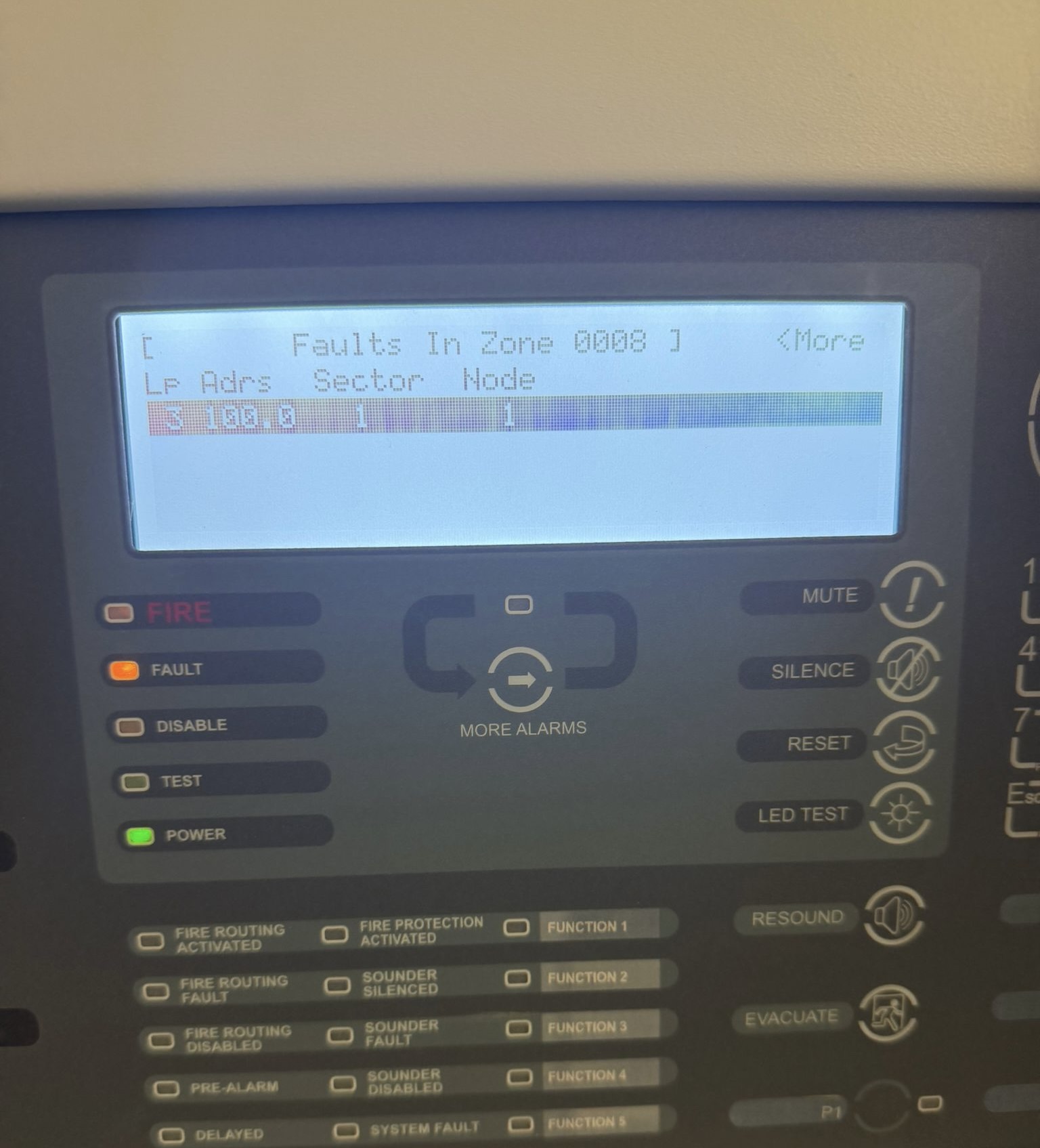
Who can carry out fire alarm testing?
BS 5839-1 requires that routine inspection and servicing is carried out by a competent person — someone with sufficient training, experience, and knowledge of fire alarm systems to carry out the work without risk to themselves or others.
The standard sets out that a competent engineer must understand detection principles, the design intent of the installed system, test procedures, fault-finding techniques, and how to interpret test results correctly. They must also be familiar with the specific make and model of the installed equipment.
- Sufficient knowledge of BS 5839-1 and its application to the installed system category.
- Ability to carry out functional tests safely, including isolating zones and panel circuits without triggering attended response.
- Understanding of how the system integrates with other fire safety measures — suppression, door-hold-open devices, ventilation shut-offs.
- Ability to produce a compliant service record and to identify when the installed design no longer meets the current standard.
Membership of an approved registration scheme — such as NICEIC — provides independent verification that an engineer meets competency requirements and is assessed regularly. This is the primary evidence a responsible person should require before appointing a service contractor.
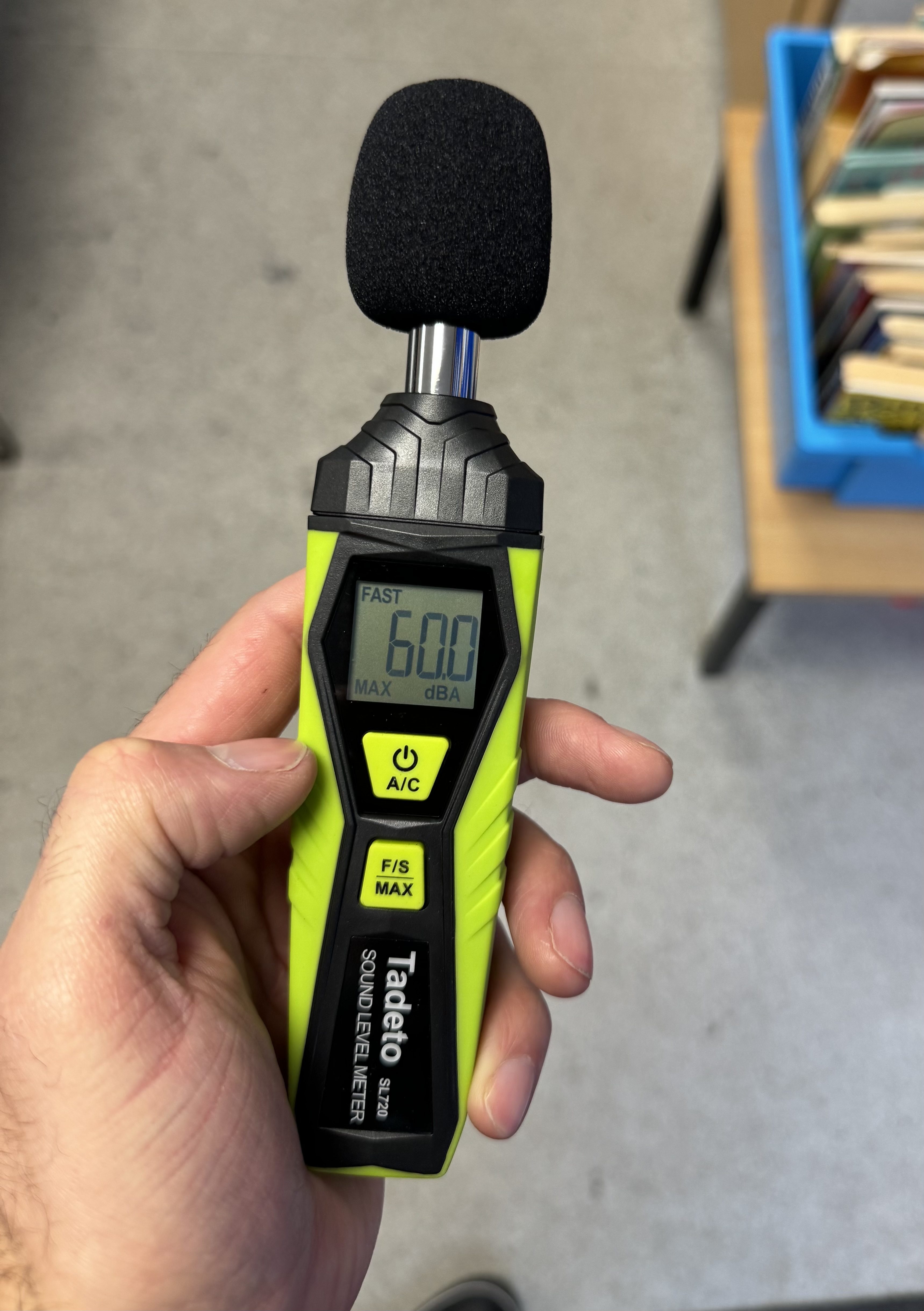
How does the process work?
Get a quote
Tell us about your premises — type, size, number of devices, system category and location. We provide a fixed price with no hidden costs. Quotes are free and you'll hear back the same day.
Book an appointment
We agree a date and time that works around your operations. We aim to attend within 5 working days. You'll receive a confirmation with the engineer's details ahead of the visit.
Pre-visit preparation
We obtain the previous service records, zone plans, and cause-and-effect schedule for the system before attending. This allows the visit to proceed efficiently and ensures we can identify any gaps in the documentation history.
Inspection and functional testing
Every detector, call point, sounder, beacon, and panel function is tested. Battery and charger condition is checked. Detector sensitivity is measured where required. Cause-and-effect logic is verified against the design intent. Results are recorded device by device.
Service certificate issued
You receive a formal service record with an overall outcome of Satisfactory or Unsatisfactory, delivered digitally. Any faults or deficiencies are recorded with a clear description and risk classification so you know exactly what action is required.
Remedial works (if needed)
If faults are found, we provide a fixed-price quote and carry out the remedial works ourselves. On completion, the affected devices are retested to confirm the system is fully operational — one company from inspection to sign-off.