EICR Testing Guide (2025) — for Landlords & Commercial Sites
Everything you need to know about Electrical Installation Condition Reports (EICR), including BS 7671:2018 requirements, legal obligations, costs, and testing procedures.
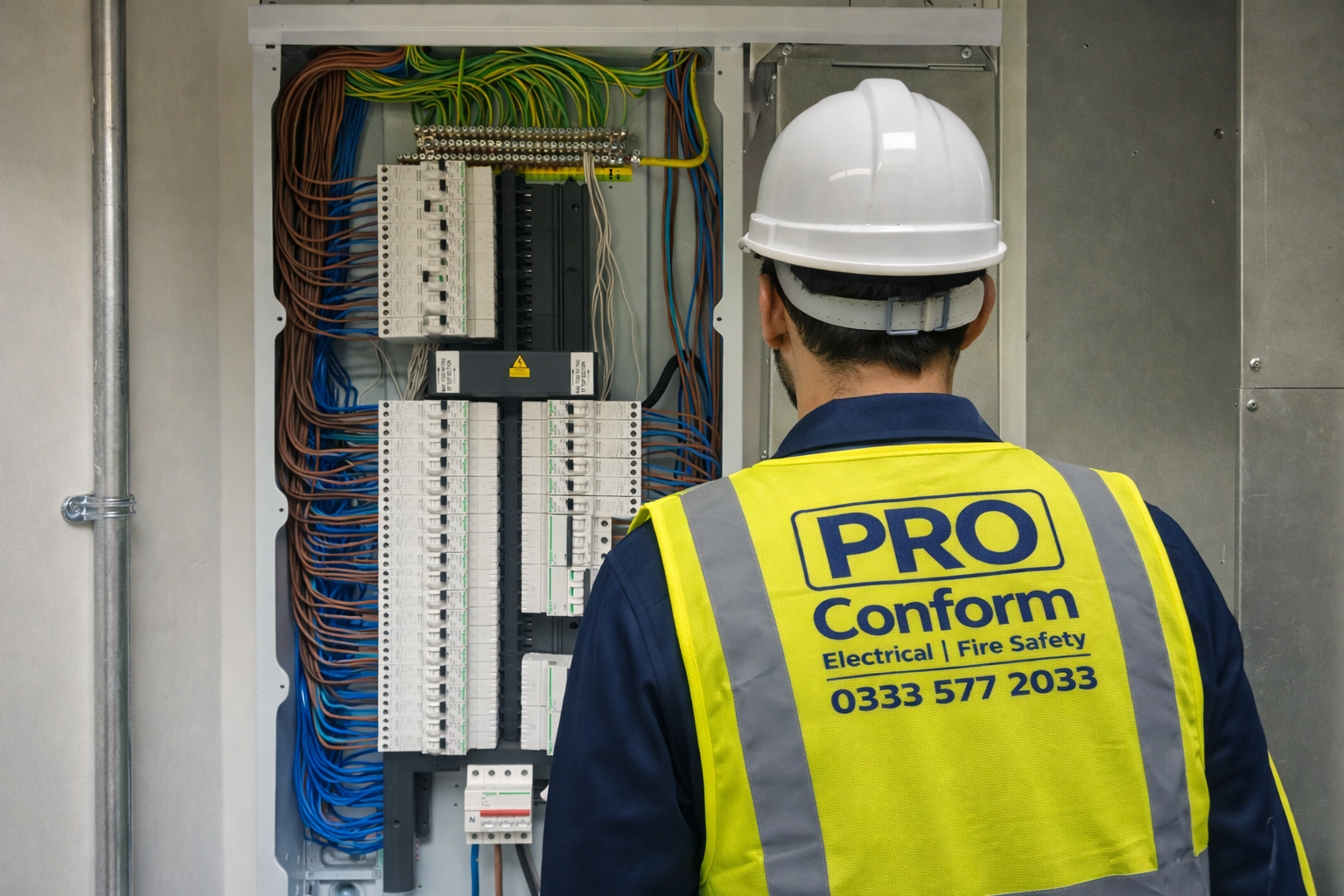
Quick Answers
What is an EICR?
An EICR is an MOT for the fixed wiring in your property. A qualified electrician checks the consumer units, circuits, earthing/bonding and safety devices against BS 7671, then issues a report marked Satisfactory or Unsatisfactory with any issues listed.
Common issues we find
Overloaded circuits, damaged/aged cabling, poor earthing/bonding, DIY alterations, missing RCD protection.
How the EICR works
1Plan & prepare
We agree a low-disruption slot, confirm access to all boards/rooms, and notify occupants (brief power-offs needed).
2Inspect & test
Visual checks, dead tests (continuity, insulation), live tests (RCD trip, loop impedance), open boards where safe.
3Plain-English report
Satisfactory or Unsatisfactory with clear actions and recommended re-test date.
Tip: Download our 10-min prep list so we can complete in one visit.
Download EICR Pre-Inspection Checklist(free)
Legal Requirements
| Property type | What the law/guidance expects | Typical interval |
|---|---|---|
| Private rented homes (England & Wales) | 5-yearly EICR; give report to tenant; fix C1/C2 promptly | 5 years |
| Private & social rented (Scotland) | Electrical safety inspection incl. EICR (plus PAT if you supply appliances) | 5 years |
| Private rented (N. Ireland) | New tenancies from 1 Apr 2025; all existing by 1 Dec 2025 | 5 years |
| Commercial/workplaces | Maintain safely (H&S/EAWR). Insurers usually require current EICR | 5 years (risk-based) |
| Owner-occupied homes | Not mandated; recommended for safety | 10 years |
If your environment is harsh/heavy-duty (industrial, wet, corrosive, outdoor), your engineer may recommend a shorter interval (e.g., 3 years).
England (Private Rentals)
- EICR required every 5 years for all privately rented residential properties
- Legal requirement since July 2020 (new tenancies) and April 2021 (existing)
- Copy of report must be given to each tenant
- C1: make safe immediately; C2: remediate within 28 days (or sooner if specified)
- Fines up to £30,000 for non-compliance
Wales (Private & Social)
- All landlords (private and social) must ensure 5-yearly electrical inspections
- Renting Homes (Wales) Act 2016 in effect since December 2022
- Contract-holders (tenants) must receive copy of report
- Urgent issues must be rectified promptly
- Property can be deemed "unfit for habitation" without valid EICR
Scotland (Leading the Way)
- 5-yearly electrical checks mandatory since around 2015
- Applies to both private and social housing landlords
- Requires EICR for fixed wiring + PAT for provided appliances
- Must use competent electrician (NICEIC or SELECT registered)
- Part of Scottish housing standards and landlord registration
Northern Ireland (NEW 2025)
🆕 New legislation phasing in 2025 under Private Tenancies Act (NI) 2022
- 1 April 2025: Valid EICR required for all new private tenancies
- 1 December 2025: Existing tenancies must have EICR
- 5-yearly inspections required, mirrors England's regulations
- Tenants to receive report within 28 days
- Illegal to let property without meeting electrical safety standards by end 2025
Commercial Properties & Workplaces
For offices, shops, industrial units, and other commercial premises, there isn't a specific "5-year EICR law" like in residential, but owners and employers have legal duties under health and safety regulations.
- Health & Safety at Work Act 1974 compliance required
- Electricity at Work Regulations 1989 duties
- 5-year EICRs considered best practice and often required by insurers
- Fire risk assessments often require current electrical certificates
- High-risk environments may need more frequent testing (3-yearly or annual)
- Enforcement action and liability risks if accidents occur
Legal Consequences of Non-Compliance
Residential Rental Penalties:
- • Fines up to £30,000 (England); Wales: property may be deemed unfit for habitation
- • Difficulty serving valid eviction notices
- • Local authority enforcement action
- • Insurance claims may be invalidated
Commercial/Workplace Penalties:
- • Unlimited fines for serious electrical safety breaches
- • Criminal prosecution under Health & Safety legislation
- • HSE improvement and prohibition notices
- • Potential manslaughter charges in case of fatalities
- • Invalidated insurance and liability exposure
Note: This is a summary of legal requirements. Always check current local authority guidance and consult qualified professionals for specific situations.
Concerned About Compliance?
Our NICEIC approved electricians handle all the technical requirements for you. Get a no-obligation quote to understand your specific needs and costs.
Get Free QuoteClassification Codes (C1, C2, C3, FI)
Every observation in your EICR is classified using standardised codes that indicate the level of urgency. Understanding these codes helps you prioritise remedial work and maintain safety.
C1 - Danger Present
Definition: Risk of injury exists, requiring immediate action to eliminate danger.
C1 – Danger Present Examples:
- • Protective device missing with exposed live parts
- • Badly damaged socket/switch with visible live wires
- • Metal parts made live due to faults
C2 - Potentially Dangerous
Definition: Urgent remedial action required to eliminate potential danger.
Common examples:
- • Circuits without RCD protection in wet areas
- • Overloaded circuits or distribution boards
- • Inadequate earthing or bonding arrangements
FI - Further Investigation
Definition: Investigation required to determine if defect exists and what action is needed.
Common examples:
- • Inaccessible areas that couldn't be inspected
- • Test results requiring specialist assessment
- • Equipment that couldn't be opened safely
C3 - Improvement Recommended
Definition: Improvement recommended to enhance safety or compliance with current standards.
Common examples:
- • Lack of additional RCD protection
- • Old cable types still functional but outdated
- • Missing surge protection devices
Things to Consider for Your EICR
Most delays aren't electrical—they're administrative. These optional services help avoid common issues like unlabelled boards, unclear responsibilities, and unresolved investigation items.
Distribution Board Labelling
Unlabelled circuits mean guesswork and accidental shutdowns. Get durable printed labels, clean front schedules, and photographed circuit records.
Same-Day C1 Safety Repair
Minor C1 defects get fixed immediately instead of being isolated, keeping your circuits in service while maintaining safety.
FI Fast-Track Investigation
Avoid "unsatisfactory" reports that drag on. Ring-fence investigation time to resolve FI items during the same visit where possible.
Free Logbok™ Trial
All your EICR documentation, photos, and schedules uploaded to secure cloud storage with automated reminders for future tests.
Compliance Saver Pack
Save time and avoid second visits with our bundled package: DB labelling (up to 3 boards) + FI fast-track (1 FI) + Logbok trial.
Leave with a clean schedule and clear action plan
Note: Minor materials included. Work must be safe to complete within pre-authorised limits with parts available. Larger works or notifiable changes are quoted separately. If access, permits, or shutdown windows are needed, we'll plan them with you.
Ready to Get Started?
Our friendly team can help you understand which services make sense for your property and provide a transparent, no-obligation quote.
BS 7671:2018 Standards
BS 7671:2018+A2:2022 (18th Edition Wiring Regulations) is the UK's national standard for electrical installation design, installation, inspection, and testing. All EICR inspections assess your electrical systems against these comprehensive technical requirements.
What Gets Tested
Electrical Safety Tests
Continuity Testing
Protective conductors, main equipotential bonding, supplementary bonding
Insulation Resistance
Between live conductors and earth, between live conductors
Earth Fault Loop Impedance
External and circuit impedance measurements
Protection Device Tests
RCD Operation Testing
Trip times at various test currents (1x, 5x rated current)
Circuit Breaker Operation
Mechanical and electrical operation verification
Polarity Testing
Correct connection of line conductors
Documentation Requirements
Installation Records
- • Original electrical installation certificates
- • Minor works certificates for alterations
- • Previous EICR reports and schedules
- • Distribution board circuit schedules
Test Results
- • Schedule of test results with measured values
- • Schedule of inspections with observed conditions
- • Photographic evidence of defects found
- • Recommendations for remedial action
Assessment Criteria
Every aspect of your electrical installation is assessed against current BS 7671 standards, regardless of when it was originally installed. However, installations compliant with earlier editions may still be acceptable if they remain safe.
Current Standards (2018+A2:2022)
- • Enhanced RCD protection requirements
- • Arc fault detection devices (AFDDs) in certain applications
- • Surge protection device recommendations
- • Updated earthing and bonding requirements
Legacy Compliance
- • Earlier editions may be acceptable if safe
- • Improvements recommended rather than mandatory
- • Focus on immediate safety rather than latest features
- • Grandfathering principle for existing installations
EICR Testing Costs UK
Small Properties
- ✓ Up to 15 circuits
- ✓ Half-day inspection
- ✓ Local properties (≤10 miles)
- ✓ Full EICR certificate
- ✓ Early booking discount included
Medium Properties
- ✓ 16-30 circuits
- ✓ Full-day inspection
- ✓ Commercial & residential
- ✓ Comprehensive testing
- ✓ Professional certification
Large Properties
- ✓ 30+ circuits (multi-day)
- ✓ Large commercial buildings
- ✓ Complex installations
- ✓ Multi-day inspection
- ✓ Detailed reporting & recommendations
What Our Customers Say
"Excellent work, provided a full explanation of what was required and delivered the work at a time that was suitable to our business. Highly recommend."
Business Owner
Commercial Property
"I've used Richard three times now, and each experience has been outstanding. Most recently, he installed an induction hob and replaced a wired bathroo..."
Homeowner
Residential Client
"First class service. From the moment we got in touch with Proconform it was obvious this was a professional company who ..."
Tony Mann
Milton Keynes · Google Local Guide
Never Miss Another Compliance Deadline
Join the waitlist for LogBok - our AI-powered compliance management platform launching 2025
Automatic Reminders
Get notified 6 months before any certificate expires
Digital Certificates
All your compliance documents in one secure place
Smart Scheduling
Automatically coordinate EICR, fire alarm, and emergency lighting
Be the first to know when LogBok launches
Early access members get 6 months free
Understanding Results
Your EICR provides a comprehensive assessment of your electrical installation's condition. The report includes visual inspections, test results, and an overall outcome that determines whether remedial work is needed.
Satisfactory Report
The electrical installation is in a satisfactory condition for continued use. Any observations noted are minor and don't require immediate action.
What this means:
- • Installation is safe for continued use
- • No urgent remedial work required
- • Next inspection due in 5 years (or as recommended)
- • Certificate valid for insurance and legal compliance
Unsatisfactory Report
The electrical installation has one or more defects that require remedial work. The severity depends on the classification codes assigned.
What this means:
- • Remedial work required before continued use
- • Action timeframes depend on defect severity
- • May need re-inspection after remedial work
- • Certificate shows limitations until fixed
Test Results & Measurements
Key Test Measurements
Insulation Resistance
Minimum acceptable values:
- • SELV/PELV circuits: ≥0.25 MΩ
- • Up to 500V systems: ≥1.0 MΩ
- • Above 500V systems: ≥1.0 MΩ
Earth Fault Loop Impedance (Zs)
Maximum values depend on circuit protection type and rating
RCD Operation
Operating time should be ≤300ms at rated current
Certificate Information
Overall Assessment
Next Inspection Date
Recommended date for next periodic inspection based on installation condition
Limitations
Any restrictions that applied during the inspection and testing
Report Structure
Key Documents Included
- • Electrical Installation Condition Report (main certificate)
- • Schedule of Inspections (visual checks completed)
- • Schedule of Test Results (measured values)
- • Photographs of defects (where applicable)
Essential Information
- • Overall assessment (Satisfactory/Unsatisfactory)
- • Next inspection date recommendation
- • Limitations during inspection
- • Summary of observations and their codes
Remedial Works & Post-EICR Action
When your EICR identifies defects, understanding what remedial work is required and managing it effectively is crucial for maintaining electrical safety. The urgency and type of work needed depends entirely on the classification codes assigned to each observation.
Urgency Levels for Remedial Work
C1 Defects - Immediate Action Required
Installation should not be used until remedied. Immediate danger present.
Typical C1 Remedial Work:
- • Install missing protective devices and blanking plates
- • Replace damaged sockets, switches and fittings
- • Repair or replace damaged cable insulation
- • Install proper covers for cable terminations
- • Fix earthing faults on metal casings
- • Correct incorrect supply polarity
Action Timeline:
- • Domestic: Immediate action
- • Rental (England): Immediate action
- • Wales/Scotland: Immediate action
- • Commercial: Immediate isolation/repair
C2 Defects - Improvement Required
Potentially dangerous. Remedial work should be carried out as soon as reasonably practicable.
Typical C2 Remedial Work:
- • Install additional RCD protection for socket circuits
- • Upgrade or replace aging consumer units
- • Improve supplementary bonding arrangements
- • Replace deteriorated wiring systems
- • Upgrade circuit protection devices
- • Install missing circuit labels and identification
Recommended Timeline:
- • Priority: Within 3-6 months
- • Rental properties: 28 days (England)
- • Commercial: Include in maintenance schedule
- • Consider: Building insurance requirements
C3 & FI Items - Future Considerations
C3: Improvements recommended. FI: Further investigation required.
C3 - Typical Improvements:
- • Upgrade to current wiring standards
- • Improve circuit identification and labeling
- • Consider additional socket outlets
- • Enhance earthing arrangements
- • Update to metal consumer units
FI - Investigation Needed:
- • Detailed assessment of inaccessible areas
- • Specialist testing of complex systems
- • Investigation of suspected defects
- • Review of installation documentation
- • Opening up concealed work if necessary
Need Professional Remedial Work?
Get expert quotes from qualified electricians for your EICR remedial work requirements.
Get Remedial Works QuoteManaging Remedial Work
Getting Quotes for Remedial Work
- Get multiple quotes from qualified electricians
- Ensure contractors are NICEIC/NAPIT registered
- Provide EICR details for accurate pricing
- Clarify what certification will be provided
- Confirm compliance with current BS 7671 standards
Typical Remedial Work Costs
Consumer Unit Replacement
£400-£800 (depending on size and complexity)
RCD Protection Installation
£150-£300 per circuit or RCBO upgrade
Bonding Improvements
£100-£250 for main bonding connections
Cable Replacement
£8-£15 per meter plus access costs
Post-Remedial Work Certification
After remedial work is completed, proper certification is essential:
Minor Works Certificate
For small additions or alterations to existing circuits
Installation Certificate
For new circuits or major modifications
Building Control
Notification may be required for certain work
Do I Need a New EICR After Remedial Work?
Generally, you don't need a completely new EICR after remedial work, but:
- Installation certificates prove compliance for new/altered work
- Minor works certificates cover small improvements
- Your original EICR remains valid for unaffected areas
- Landlords may request updated EICR for tenant assurance
- Insurance companies may require verification
- Significant changes may warrant updated assessment
Working with Contractors
Before Work Starts:
- • Verify contractor registrations and insurance
- • Agree scope of work and timeline
- • Understand what certificates will be provided
- • Clarify cleanup and making good arrangements
After Completion:
- • Obtain all relevant certificates
- • Keep records for future reference
- • Update building control if required
- • Inform insurance company of improvements
Connect with Qualified EICR Specialists
Skip the contractor search - get connected with certified professionals who understand EICR remedial work requirements.
Get Remedial Works QuoteEICR Testing Frequency Requirements
The frequency of EICR testing depends on the type of property, its use, and the legal requirements in your jurisdiction. Understanding these requirements ensures you maintain compliance and electrical safety.
Legal Requirements by Jurisdiction
England - Electrical Safety Standards in the Private Rented Sector
Mandatory Requirements:
- • Private rental properties: Every 5 years maximum
- • At change of tenancy (if no valid EICR)
- • New tenancies from July 2020
- • Existing tenancies from April 2021
- • Houses in Multiple Occupation (HMOs): Every 5 years
Landlord Obligations:
- • Provide copy to tenant within 28 days
- • Retain records for inspection
- • Remedial work within 28 days (C1/C2)
- • Provide to local authority if requested
Wales, Scotland & Northern Ireland
Wales
Similar to England but check Rent Smart Wales guidance
- • 5-year maximum intervals
- • Additional HMO requirements
Scotland
Check latest Scottish Government guidance
- • Evolving regulations
- • May require more frequent testing
Northern Ireland
Check Department for Communities requirements
- • May differ from England
- • Consult local guidance
Recommended Testing Intervals by Property Type
| Property Type | Frequency | Legal Status | Notes |
|---|---|---|---|
| Private Rental (England) | Every 5 years | Mandatory | Legal requirement since 2020 |
| Commercial Offices | Every 5 years | Recommended | Insurance often requires compliance |
| Industrial/Manufacturing | Every 3 years | Recommended | Harsh environments require more frequent testing |
| Hotels & Hospitality | Every 5 years | Recommended | High occupancy requires regular testing |
| Schools & Public Buildings | Every 5 years | Recommended | Public safety considerations |
| Healthcare Facilities | Every 1-3 years | Critical | Patient safety requirements |
| Residential (Owner-Occupied) | Every 10 years | Recommended | Or at change of ownership |
Factors Affecting Frequency
- Age and condition of installation
- Environmental conditions (damp, heat, chemicals)
- Type and intensity of use
- Previous EICR findings
- Insurance company requirements
Planning Your EICR Schedule
- Book EICR 2-3 months before expiry
- Consider seasonal access (gardens, outbuildings)
- Coordinate with other maintenance work
- Set calendar reminders for renewal
- Budget for potential remedial work
Special Circumstances Requiring More Frequent Testing
Environmental Factors:
- • Coastal properties (salt corrosion)
- • Industrial environments
- • Agricultural settings
- • Properties with swimming pools
- • Areas with chemical exposure
Usage Factors:
- • High electrical loads
- • Frequent alterations/additions
- • Previous significant defects
- • Temporary installations
- • Critical safety systems
Choosing the Right EICR Contractor
Selecting a competent and qualified contractor is crucial for obtaining a reliable EICR that accurately reflects your installation's condition. The quality of your EICR depends entirely on the skills and integrity of the person carrying it out.
Essential Qualifications & Registrations
Competent Person Scheme Registration
NICEIC Registration:
- • Approved Contractor status
- • Regular technical assessments
- • Insurance backed warranty
- • Complaints procedure
- • Check at niceic.com/find-a-contractor
NAPIT Registration:
- • Competent person status
- • Annual inspections
- • Technical support
- • Professional indemnity
- • Verify at napit.org.uk
Required Qualifications
Technical Qualifications
- • C&G 2391 Inspection & Testing
- • C&G 18th Edition (BS 7671)
- • NVQ Level 3 Electrical
- • Relevant trade experience
Professional Requirements
- • Public liability insurance
- • Professional indemnity cover
- • Calibrated test equipment
- • Current competency assessment
Skills & Experience
- • Domestic installation experience
- • Knowledge of current standards
- • Understanding of inspection procedures
- • Report writing competency
Questions to Ask Potential Contractors
Verification Questions
- Can you provide your NICEIC/NAPIT registration number?
- What inspection and testing qualifications do you hold?
- Can you show evidence of insurance cover?
- When were your test instruments last calibrated?
Process Questions
- What does your EICR inspection process include?
- How long will the inspection take?
- What happens if defects are found?
- Do you provide quotes for any remedial work needed?
Red Flags to Avoid
Warning Signs of Poor Contractors
Qualification Issues:
- • Cannot provide scheme registration details
- • Reluctant to show qualifications
- • No evidence of recent training
- • Unregistered or expired registration
- • Claims "anyone can do an EICR"
Process Concerns:
- • Promises unrealistically quick inspection
- • No mention of testing procedures
- • Guarantees to \"pass\" before inspection
- • Pressure to book remedial work immediately
What Good Contractors Provide
- Clear explanation of the inspection process
- Comprehensive written quotation
- Professional certification upon completion
- Clear explanation of any findings
- Honest assessment without sales pressure
- Professional appearance and conduct
Comparing Quotes
What to Compare:
- • Scope of inspection included
- • Time allocated for inspection
- • Certification provided
- • Timeline for report delivery
- • Total cost including VAT
Remember:
The cheapest quote may not represent the best value. A thorough EICR requires proper time and expertise.
Get Your Professional EICR Today
BS 7671:2018 compliant testing from NICEIC approved contractors. Same day testing, certificates within 48 hours.